


Contact Us
Get in Touch
wallstreetzoningpilot@gmail.comFollow Us

Three Changes. One Neighborhood.
Time-Limited Pilot.
The Wall Street Pilot Zoning Overlay asks for three targeted changes. Versions of two of the proposed changes existed in Norwalk's earlier zoning code. The 2023 citywide rewrite removed them. We're asking for them back, plus one new idea.
Change 1: District Parking
What it is:
Properties within the Wall Street district would be exempt from on-site parking minimums, relying instead on the district's shared public parking system.
Why it makes sense:
Wall Street has 4 public parking facilities totaling 1,700 spaces. At peak occupancy (Saturday afternoon), only 48% of spaces are used — meaning 800+ spaces sit empty even on the busiest day. Requiring individual buildings to provide their own parking when abundant shared parking exists is redundant, expensive, and often physically impossible in historic buildings.
The 105 naturally affordable apartments built in this neighborhood over the past decade were possible because of a prior rule exempting renovations within 1,000 feet of a municipal parking facility. The 2023 citywide zoning rewrite eliminated parking requirements entirely — but a year later, the city reinstated them with no relief for Wall Street. The current parking rules are now worse than they've been in over a decade.
Safeguards:
Annual parking occupancy monitoring
Applies only within the Wall Street district boundary
Pilot can be reversed if occupancy data shows stress on the system
This already exists in state law: HB 8002, signed by Governor Lamont in November 2025, eliminates parking minimums statewide for projects under 16 units and eliminates parking minimums when a parking evaluation shows there is sufficient public parking in the neighborhood. We're asking for the same logic applied to Wall Street.
Change 2: More Choices, More Neighbors
What it is:
Remove the arbitrary unit count cap that ties the number of apartments to lot size. Building size, height, setbacks, and architectural character rules stay exactly the same.
Why it makes sense:
Under current rules, a 300 sq ft studio and a 2,500 sq ft four-bedroom both count as "one unit" — and the total units allowed is capped based on lot size. This discourages variety. It pushes developers toward fewer, larger, more expensive apartments. It makes live/work studios and small one-bedrooms economically unviable.
Removing the unit cap doesn't make buildings bigger. It lets the same building envelope contain more appropriately-sized apartments — studios, one-bedrooms, live/work spaces — instead of fewer large ones.
Who benefits:
Young professionals, artists, students, service workers, people who choose walkable urban life. The people who make a neighborhood alive.
Safeguards:
All other zoning rules (height, FAR, setbacks, design standards) unchanged
Annual monitoring of rent levels
Pilot only — reversible
Change 3: Small-Project Relief
What it is:
Projects of 19 units or fewer would pay a fee into the city's Affordable Housing Fund instead of providing deed-restricted affordable units on-site.
Why it makes sense:
Wall Street already has significant deed-restricted affordable housing — Wall Street Place (155 units, 100% affordable), 24 Belden (30% affordable), Head of the Harbor (10% workforce). Small projects in Wall Street naturally produce rents that are well below the Affordable threshold without any program — because the units are smaller, older, and in a walkable location that doesn't command a premium.
Requiring small projects to navigate the same compliance machinery as 200-unit buildings creates cost and delay that kills projects that would otherwise happen. The fee alternative keeps money flowing to the city's affordable housing fund while removing a barrier to small-scale development.
Safeguards:
Fee goes directly to city Affordable Housing Fund
Threshold is 19 units or fewer — above that, standard requirements apply
Annual monitoring
Wall Street Zoning Pilot Area
The Wall Street Zoning Pilot covers the same streets where the City of Norwalk is investing $30 million in infrastructure improvements — wider sidewalks, bike lanes, festival streets, and gateway features. This isn't a coincidence. The city has already identified this area as the place to invest. The zoning should match. The purple streets on this map are the TMP Corridor Improvement Project. That's our pilot boundary. Small. Targeted. Exactly where the city is planting seeds for growth.
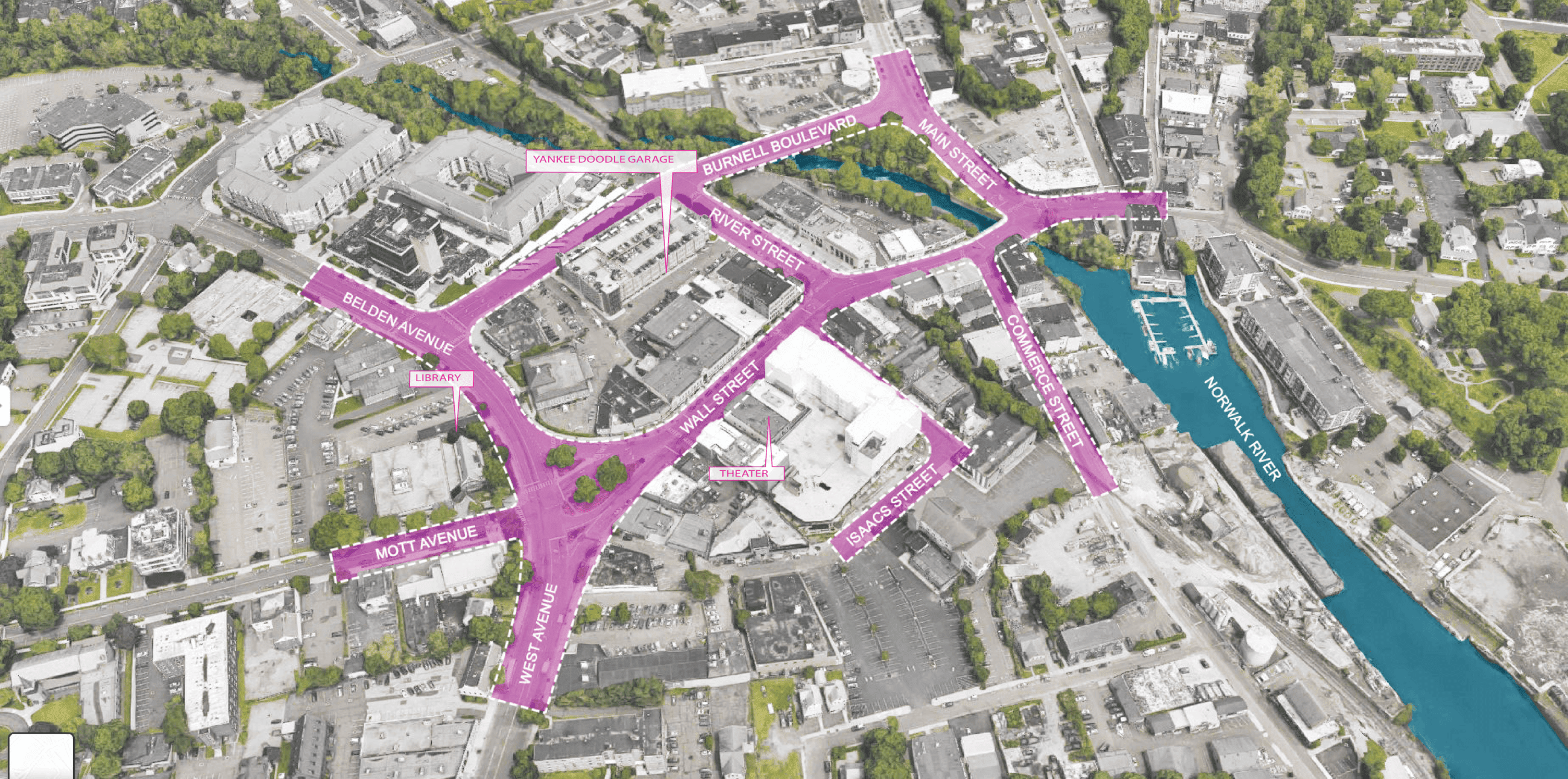
Wall Street Corridor Improvement Project — City of Norwalk / TMP. The same streets receiving $30M in city and federal infrastructure investment define the proposed zoning pilot boundary.
Duration: 3–5 years
Geography: Wall Street district only
Monitoring: Annual review of rents, parking occupancy, and development activity
Reversibility: Full reversion to prior rules if data shows negative outcomes
Oversight: Norwalk Planning & Zoning Commission
Around the Neighborhood


.jpg)


